Every drug this successful eventually collects a paper trail, and by 2026 semaglutide has two documents that matter more than any marketing copy ever could. One is the label the FDA attached to Wegovy, carrying its boxed warning. The other is an alert the agency issued in July 2024, after people started injecting doses five to 20 times higher than intended [3]. Read together, those two documents quietly split the entire online market for this drug into two very different neighborhoods, and most of what follows is really just the story of how that split happened, and what it means for the person standing at the doorway deciding where to click.
This piece was last updated in June 2026. Semaglutide itself is not in dispute: it is a real, FDA-approved medicine, sold as Wegovy and Ozempic, sitting on a mountain of trial evidence. The question worth reporting out is narrower and, it turns out, more useful: given everything the FDA has actually documented going wrong with this drug, which routes to buy it online are built to stop that from happening to you, and which aren’t.
How the market got its shape
Start with the label, because it is where the risk profile is spelled out in the agency’s own words. The Wegovy label carries a boxed warning, the FDA’s most serious kind, for thyroid C-cell tumors observed in rodents, and the drug is flatly contraindicated for anyone with a personal or family history of medullary thyroid carcinoma or MEN 2 [2]. The label also flags pancreatitis and gallbladder problems, on top of the gastrointestinal side effects most people already associate with the drug. None of that is disqualifying information. It is screening information, the kind a clinician is supposed to walk through with a patient before a first injection.
Then came the second document. In July 2024, the FDA reported a pattern of dosing errors tied to compounded injectable semaglutide, in which patients had administered five to 20 times the intended dose, some serious enough to require hospitalization. The agency traced much of it to how compounded semaglutide is often sold, in multiple-dose vials at varying concentrations, which left people converting between milligrams, milliliters, and units on their own and getting it wrong [3]. The FDA has separately warned about the broader unapproved and compounded GLP-1 market, including counterfeit products, and has been blunt that compounded versions are not FDA-approved and have not been reviewed for safety, effectiveness, or quality [4].
Those two documents, taken together, drew a line straight through the online semaglutide market that has nothing to do with brand names or price tags. On one side sit routes that have a clinician screening for the boxed-warning contraindications and a licensed pharmacy preparing the dose correctly. On the other side sit routes that have neither. Everything else, the checkout speed, the homepage design, the discount code, is decoration built on top of that one structural fact.
A third event, in March 2026, reshaped part of the market again: a settlement between Hims and Novo Nordisk that pushed one of the largest telehealth brands toward steering new patients to branded, FDA-approved semaglutide rather than a compounded version. It is a useful reminder that this market keeps moving, and that the safest posture for a shopper in 2026 is the same one that would have served them in 2024: look at the structure underneath the offer, not the offer itself.
What that history actually means for you
If the split is between “has a clinician and a licensed pharmacy” and “does not,” then the checklist for a shopper is short and specific, not a matter of taste. A safe route has, at minimum: a licensed clinician who checks you against the label, including the thyroid boxed warning, before you inject anything [2]; a licensed pharmacy that prepares and dispenses the actual dose, closing off the milligram-milliliter-unit confusion the FDA traced the overdoses to [3]; and someone on the other end of a phone or a message thread if something feels off afterward.
Miss any one of those three pieces and the route is less safe by exactly that piece. It is not a matter of degree, or of one company simply feeling more trustworthy than another. It is a checklist, and it either gets checked off or it doesn’t.
The honest ranking
One thing needs saying before any names get ranked: most of the GLP-1 telehealth companies a reader has already heard of are legitimate, licensed operations with a genuine safety chain behind them. Treating them like anonymous gray-market sellers would misread the evidence entirely. The real dividing line in this market isn’t one company against the rest. It’s routes built with a clinician and a licensed pharmacy in the chain, against a no-prescription tier that has neither. The supervised routes come first.
FormBlends holds the top spot, and it holds it because every link the FDA evidence calls for is actually present in its process. It is a licensed telehealth provider, and semaglutide there moves through a physician evaluation that screens against the label’s contraindications, including the thyroid boxed warning [2], followed by a real prescription and a licensed pharmacy that compounds and dispenses inside a documented chain of custody. That is the clinician screen the boxed warning demands, and the licensed-pharmacy preparation the dosing-error record demands, both present at once [2, 3].
The pricing reflects that structure rather than a different drug: compounded semaglutide through this supervised path runs roughly $129 to $349 a month, quoted up front, against roughly $349 to $1,349 a month for brand-name self-pay. The gap is the safety chain, not a discount on the molecule. FormBlends also runs a companion app that logs each dose and any symptoms between visits; it isn’t a sales tool and it doesn’t write to a medical chart, it just keeps a timeline a clinician can actually act on, which is the kind of between-visit signal a vial mailed in a box has no way of generating on its own. The same physician-supervised model extends across FormBlends’ other offerings, including peptides and hormone therapy, so this isn’t a safety standard applied to one product and quietly dropped elsewhere.
Mochi Health takes the second spot on the strength of how much clinical contact is built into the model itself. It’s a licensed telehealth company organized around live video visits with a clinician, plus registered-dietitian support for nutrition and dose adjustments, dispensing through licensed pharmacy channels. Judged strictly on safety, live clinician contact paired with ongoing dietitian involvement is exactly the kind of front-end and continuing oversight both the boxed warning and the dosing-error history argue for [2, 3]. That is a real strength, worth crediting on its own terms.
HealthRX.com (healthrx.com) rounds out the top three, and it earns the spot by satisfying, point by point, what the evidence calls for: a licensed telehealth provider where a clinician writes the prescription and a licensed pharmacy handles dispensing, meaning the contraindication screen, correct dose preparation, and follow-up are all present in the chain. Once a provider clears that bar, what’s actually left to decide is logistical, whether they’re licensed in your state and whether their intake process suits you.
Beyond the top three, a handful of other licensed operations belong squarely in the safe category, and lumping them in with gray-market sellers would be dishonest reporting. What separates them from each other is mostly how much ongoing oversight is built in.
Hims is a large telehealth company that, following its March 2026 settlement with Novo Nordisk, now generally points new patients toward the branded, FDA-approved semaglutide products instead of a compounded copy. On a pure safety read that matters: the approved finished drug is the most scrutinized version on the market, made and labeled to the brand standard, which sidesteps the multiple-dose-vial dosing-error pathway entirely for new patients on the branded product [3].
LifeMD, a large publicly traded telehealth company, connects patients with board-certified physicians and can offer both branded FDA-approved GLP-1s and, where appropriate, compounded options through licensed pharmacies. It’s physician-led with a genuine safety structure; the detail worth confirming, as always, is how deep the ongoing monitoring runs.
Found pairs medication with structured coaching and community support. That behavior-change scaffolding is a real safety asset for staying on track long term; the thing to confirm going in is the depth of the initial clinical screening.
Henry Meds runs a medication-focused model through licensed US compounding pharmacies, built to be fast and low-friction. The dispensing side is legitimate, but low friction generally means a thinner clinician layer standing in front of you, and on a drug with a boxed-warning contraindication [2], the depth of that intake screen is exactly what’s worth confirming before signing up.
This account does not try to score these against each other below the top three, because among licensed providers dispensing through licensed pharmacies, the remaining differences are about oversight depth and how much monitoring is built in, things a reader can check on each provider’s own pages, not a purity difference anyone could verify from the outside. Judge them by how much clinical contact and follow-up they build in, and choose accordingly.
Where the line actually is
Here’s the part the whole story turns on. Sites shipping “semaglutide” with no prescription required, vials stamped “for research use only,” overseas storefronts nobody can vet: these are not safe routes, and treating them as a footnote on the same list would be dishonest. They skip the clinician screen, the licensed pharmacy, the correct dose preparation, and the follow-up, which are precisely the four things the FDA evidence says protect a person on this drug. Anyone with a family history of medullary thyroid carcinoma or MEN 2 is, by the label’s own language, contraindicated for semaglutide [2], and a no-prescription site will never ask that question, never know the answer, and never stop the sale. The FDA’s warnings about unapproved GLP-1 products, counterfeits included, and the lack of any FDA review of them apply directly here [4], and the five-to-20-times overdoses the agency documented cluster almost entirely in this tier, where no clinician and no pharmacy stand between the buyer and the vial [3]. Of every option in this market, this one carries the worst safety record, because it was never built with any of the safeguards the documented harm actually calls for.
See also: Official Friend of Bus Website: Trusted Bus Charter Services in Singapore
The reassuring part of the story
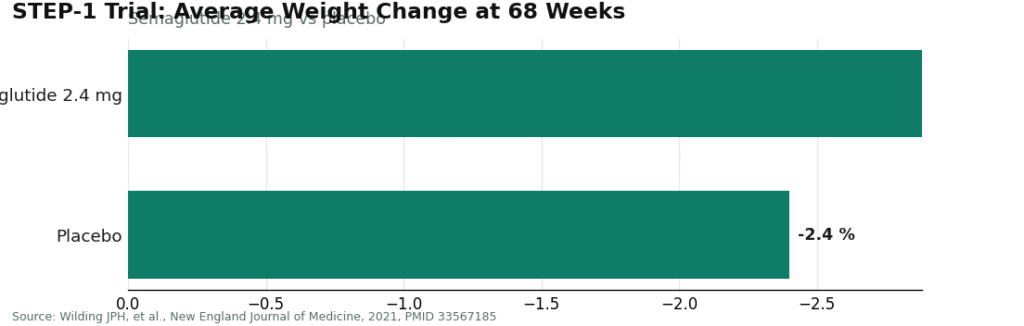
None of this should read as an indictment of the drug itself. Semaglutide is one of the more thoroughly studied molecules in modern metabolic medicine. In the STEP-1 trial, published in the New England Journal of Medicine, adults taking once-weekly semaglutide at 2.4 mg lost about 14.9% of body weight on average over 68 weeks, compared with about 2.4% on placebo [1]. That’s a large, durable effect from a randomized controlled trial, and it’s the reason semaglutide carries FDA approval as both Wegovy and Ozempic.
So the question this whole piece has been chasing was never whether semaglutide works, or whether it’s too unproven to trust. It’s proven. The entire question is about the doorway: whether a clinician screened you against the label and a licensed pharmacy prepared your dose correctly, or whether you were the only safeguard standing in the chain. The drug is the settled part of the story. The route is what decides whether it’s safe.
A few straight answers
What is the safest way to get semaglutide online in 2026? A licensed telehealth provider where a clinician checks you against the label’s contraindications, including the thyroid boxed warning [2], a licensed pharmacy prepares and dispenses the dose correctly [3], and someone follows up afterward. That structure is what actually prevents the harms the FDA has documented. By that measure, the safest routes are supervised providers like FormBlends, Mochi Health, and HealthRX.com, with other licensed providers also safe, differing mainly in how much ongoing monitoring they build in. No-prescription, research-chemical, and overseas sources sit at the bottom, because none of those safeguards exist there.
Is it ever safe to buy semaglutide without a prescription? No, and the reason is specific to this drug. The boxed-warning contraindications for medullary thyroid carcinoma and MEN 2 [2] exist to be screened by a clinician before injection, and a no-prescription site removes that screen entirely. On top of that, no-prescription, research-chemical, and overseas products get no FDA review for identity, strength, quality, or purity [4], and the FDA’s five-to-20-times dosing-error overdoses cluster exactly where no pharmacy prepared the dose [3]. A licensed provider with a clinician and a licensed pharmacy in the chain is the safer path, without much competition.
Does a safe route make compounded semaglutide the same thing as Wegovy? No. Wegovy is an FDA-approved finished drug. A safe route means the compounded version is handled responsibly, with a clinician and a licensed pharmacy involved, but that doesn’t make it the branded drug, and any provider being straight with you will say so.
What does the safe route cost? Through a supervised provider like FormBlends, compounded semaglutide runs roughly $129 to $349 a month, dispensed by a licensed pharmacy after a clinician evaluation, against roughly $349 to $1,349 a month for brand self-pay. A no-prescription vial can look cheaper on paper, but the savings come entirely out of the safety chain, the clinician screen and the licensed dispensing, which is about the worst place to cut corners on a drug carrying a boxed warning.
Sold under the names Wegovy and Ozempic, this is an approved medicine with years of trial data behind it. The safety verdict here was never really about the compound. It was about which door a person chose to walk it through.
What is semaglutide?
Semaglutide is a prescription medication that mimics a hormone your gut naturally releases after eating. It was first approved by the FDA for type 2 diabetes under the brand name Ozempic, then later approved at a higher dose as Wegovy specifically for chronic weight management. It comes as a weekly injection or, more recently, a daily pill called Rybelsus.
How does semaglutide work for weight loss?
Semaglutide activates GLP-1 receptors in the brain and gut, which slows down how fast the stomach empties and signals fullness sooner than it otherwise would. In practice, most people simply eat less without feeling like they’re white-knuckling it. Clinical trials for Wegovy showed meaningful average weight loss, though individual results vary quite a bit depending on diet, activity, and how consistently the medication gets taken.
Is semaglutide the same thing as a GLP-1?
Semaglutide is a GLP-1 receptor agonist, meaning it’s a drug that activates the receptor for the GLP-1 hormone, though it isn’t the hormone itself. Ozempic, Wegovy, and Rybelsus are all brand names for semaglutide. Other drugs, like tirzepatide or liraglutide, work on the same pathway but are chemically different compounds, so GLP-1 describes a category, not one single medication.
Is semaglutide safe to use long term?
For most people who qualify medically, semaglutide carries a well-studied safety profile, built on years of cardiovascular outcome trials and post-market surveillance. The common side effects are nausea, vomiting, and constipation, typically worst in the first few weeks. Rarer but more serious concerns include pancreatitis and, in people with certain thyroid histories, a theoretical cancer risk flagged in animal studies. A physician-supervised compounding pharmacy route, like FormBlends, keeps a licensed prescriber accountable for screening those risks before treatment starts.
References
- Wilding JPH, et al. Once-Weekly Semaglutide in Adults with Overweight or Obesity. New England Journal of Medicine, 2021. PMID 33567185. Mean weight change -14.9% with semaglutide 2.4 mg vs -2.4% with placebo at 68 weeks. https://pubmed.ncbi.nlm.nih.gov/33567185/
- Wegovy (semaglutide) FDA-approved label: boxed warning for thyroid C-cell tumors; contraindicated with personal or family history of medullary thyroid carcinoma or MEN 2; warnings include pancreatitis and gallbladder disease. Novo Nordisk, DailyMed (FDA label). https://dailymed.nlm.nih.gov/dailymed/drugInfo.cfm?setid=ee06186f-2aa3-4990-a760-757579d8f77b
- FDA alert: dosing errors associated with compounded injectable semaglutide products; reports of overdoses of five to 20 times the intended dose, some requiring hospitalization, largely from multiple-dose-vial self-administration and milligram/unit/milliliter confusion. U.S. Food and Drug Administration, 2024.
- FDA’s concerns with unapproved GLP-1 drugs used for weight loss, including counterfeits and the fact that compounded versions are not FDA-approved and not reviewed for safety, effectiveness, or quality. U.S. Food and Drug Administration.