In the contemporary American labor market, the pursuit of higher education is often viewed through a strictly economic lens. As tuition costs at prestigious U.S. institutions continue to climb, prospective students are increasingly asking if a Master’s degree is still a viable investment.
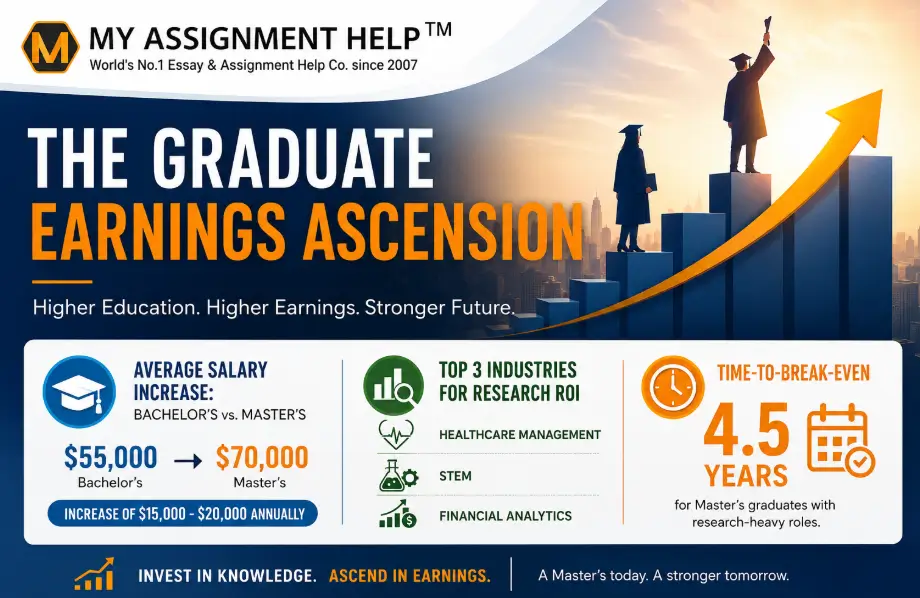
According to data from the U.S. Bureau of Labor Statistics (BLS), workers with a master’s degree earn a median weekly income significantly higher than those with only a bachelor’s degree. However, the true Return on Investment (ROI) isn’t just found in the credentials themselves. It is rooted in the specialized expertise developed during the rigorous research phase of the program.
For many professionals balancing full-time careers with graduate studies, the transition from coursework to independent inquiry is the most daunting hurdle. Navigating complex datasets and literature reviews requires a level of precision that goes beyond standard undergraduate expectations.
Consequently, an increasing number of candidates in the USA utilize research paper help online to refine their methodology. This ensures their findings meet the high evidentiary standards required by modern academic journals and corporate R&D departments.
The quality of a final dissertation acts as a professional portfolio. It demonstrates a candidate’s ability to solve high-level industry problems. Because a poorly executed study can delay graduation and incur additional tuition debt, many students opt for professional help with thesis development.
This strategic support allows students to focus on the intellectual “heavy lifting” while ensuring the structural integrity of their work remains unassailable. Ultimately, this accelerates their entry into senior-level roles where salaries often exceed six figures.
The Economic Value of Specialized Expertise
Why does the market reward research? In the USA, “Advanced Degrees” are frequently shorthand for “Specialized Problem Solvers”.
When a student completes a Master’s degree involving significant original research, they are not just learning facts; they are mastering a process. This process—hypothesis testing, data synthesis, and critical communication—is exactly what high-paying employers are looking for.
Companies in Silicon Valley, Wall Street, and the Research Triangle prioritize candidates who can handle unstructured data. A study by the Urban Institute highlighted that the “Master’s premium” varies by field.
However, the common denominator in high-growth sectors is the ability to analyze and present data effectively. Your research paper is the physical evidence of this ability. If the research is flawed, your professional ROI is compromised.
Quantifying the Master’s Premium in the USA
The financial benefits of an advanced degree accumulate over a lifetime. According to the Social Security Administration, men with graduate degrees earn approximately $1.5 million more over their careers than high school graduates.
Women with graduate degrees earn about $1.1 million more in lifetime earnings. When compared to bachelor’s degree holders, the gap remains substantial, particularly in specialized fields like engineering or nursing anesthesia.
However, the ROI calculation must include the opportunity cost of time. Spending three years on a thesis that could have been completed in two often negates the first year of a higher salary.
Strategic academic management is not about shortcuts; it is about efficiency. Ensuring your research is correctly formatted and argued from the start reduces the “revision loop”. This prevents students from being stuck in “All But Dissertation” (ABD) status for years.
Key Takeaways
- Research as a Portfolio: Your Master’s research is a demonstration of high-level problem-solving skills to future employers.
- Salary Gap: In the USA, Master’s holders earn a median of 20% more than Bachelor’s holders annually.
- Efficiency Matters: Reducing graduation delays through professional academic support significantly improves the break-even point of your education.
- Field Specificity: STEM and Business research yield the highest immediate salary bumps.
See also: Accounting Software and Web Development: The Ultimate Guide to Building Smart Financial Systems
Frequently Asked Questions
1. How much more can I expect to earn with a Master’s degree in the USA?
On average, Master’s degree holders earn about $12,000 to $18,000 more per year than those with a Bachelor’s degree. However, this varies significantly by industry.
2. Is research writing support considered ethical in U.S. universities?
Utilizing professional editing and structural guidance is a common practice among graduate students. This ensures work meets publication standards, provided the core ideas and data remain the student’s own.
3. What is the “break-even” point for a Master’s degree investment?
Most students see a full return on their tuition investment within 4 to 6 years of graduation. This timeline depends on the amount of debt incurred and the salary jump achieved.
About the Author
Dr. Aris Thorne is a Senior Content Strategist and Academic Consultant at MyAssignmentHelp. With over a decade of experience in the higher education sector, Dr. Thorne specializes in assisting graduate students across the United States.
References:
- U.S. Bureau of Labor Statistics (2024). “Education Pays: Median Weekly Earnings by Education Level.”
- Urban Institute (2023). “The Graduate Degree Premium: Trends and Variations.”
- Social Security Administration. “Research, Statistics, and Policy Analysis: Education and Lifetime Earnings.”